All About Moonstone and Labradorite-What Do These Gemstones Have in Common?
With their shifting playful movement of light, silvery bluish glows and flashes of vivid colour moonstone and labradorite can appear almost otherworldly and it is no wonder that moonstone, in particular, has been trending so much this year online and in the US. Back in December 2025 Pantone announced the colour of 2026 was going to be Cloud Dancer; a soft billowy white shade, moonstone was one of our predictions for the most popular gemstone in 2026 and we were right! Well, in the US anyway!
Unlike the brilliance and sparkle of a diamond, the beauty of moonstone and labradorite lies in their optical effects which come from within the gemstones themselves. Their optical phenomena are unique and captivating making you want to just keep turning the stones and staring hypnotically into their features. It is these effects that make them so popular and sought after.
Although moonstone and labradorite look different, they do share an important connection: both belong to the feldspar mineral family, one of the most abundant groups of minerals in the Earth’s crust and have been admired for centuries. From ancient folklore to contemporary jewellery design, these fascinating gemstones offer a wonderful combination of natural science, history and understated elegance so let’s discover more about these beautiful playful gemstones.
What Are Moonstone and Labradorite?
Feldspar is a large family of rock-forming minerals found in igneous, metamorphic and sedimentary rocks. Although feldspar is incredibly common, only certain varieties possess the qualities needed to become attractive gemstones.
Moonstone is generally a lighter, whiter or translucent based stone and has microscopic internal structures which scatter light to produce its characteristic floating sheen. The soft floating sheen (also known as The Schiller Effect) is called adularescence and is caused by light diffraction through alternating layers of orthoclase and albite feldspar.
Labradorite has a darker base and many incipient cleavage cracks which refract and reflect light to produce the shimmering blue and other colourful effects. The optical effect in labradorite is called labradorescence. Both are different varieties of feldspar. Their shared mineral heritage explains some of their similarities, but the way each gemstone interacts with light gives it a distinctive personality.
Moonstone and labradorite are commonly cut as a cabochon rather than a faceted gemstone although some faceted stones are found. This smooth, domed finish helps display its characteristic glow, making it a natural choice for pendants, earrings, and other designs where the gemstone can be appreciated as it catches the light.
Both gemstones typically have a hardness of 6–6.5 on the Mohs scale, making them suitable for jewellery, provided they are designed and worn with a little care. Caution is advised when these stones are set in rings as they will scratch and abrade more easily.
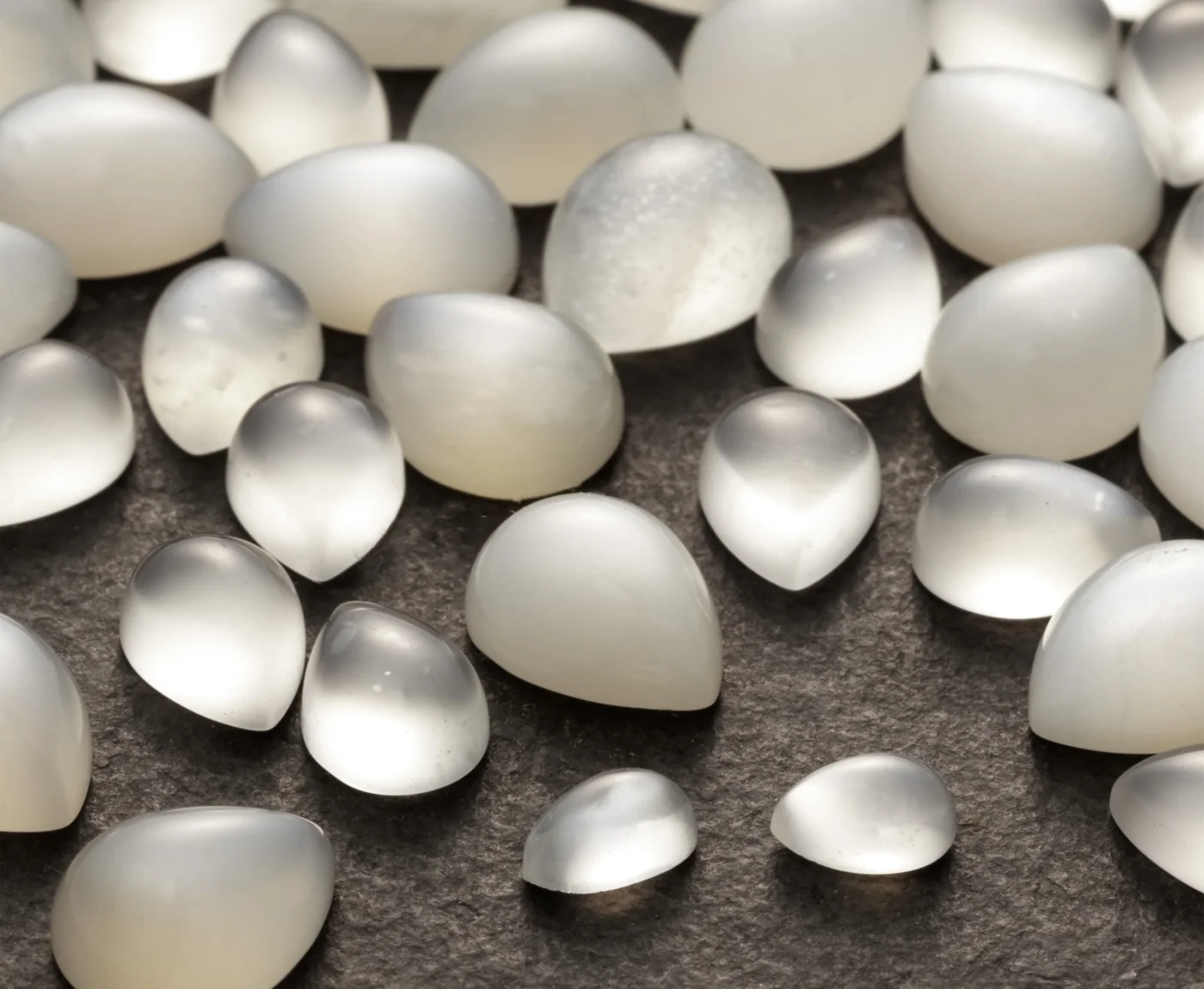
White moonstone cabochon stones with a soft white glow on a milky base. Image courtesy of Kernow Craft.
Moonstone: A Moonlight Serenade
Moonstone takes its name from its beautiful, ethereal appearance. Its soft, luminous sheen resembles moonlight shining on a still lake at night, creating a gentle glow that seems to dance beneath the surface as it is gently moved.
The most desired moonstone has a translucent, colourless or milky-white body with an intense, electric-blue shimmer. However, moonstone occurs in a much wider palette, including grey, peach, cream, green, brown and almost black. Some stones display a subtle beautiful white glow instead of the blue shimmer like our Art Deco inspired moonstone and diamond pendant below.
Where Is Moonstone Found?
Important sources of moonstone include Sri Lanka, India, Madagascar, Myanmar and Tanzania. The appearance of the material varies between localities, and the source alone does not determine its quality.
Sri Lanka is particularly well known for fine, translucent moonstone with a blue sheen. India produces a wide variety of material, including peach, grey and white moonstone, while Madagascar has become an important source of attractive gem-quality feldspars.
Moonstone Folklore
Moonstone has long been associated with the Moon, femininity, intuition and new beginnings. In Hindu mythology, it has traditionally been described as being formed from moonbeams bringing harmony and calm, a poetic explanation that seems particularly fitting for its appearance.
In various traditions, moonstone has also been regarded as a talisman for travellers, especially those journeying at night and for crystal healers it is a stone that can connect you to your ancestors in heaven. It has been associated with love, emotional balance and good fortune, and has sometimes been exchanged as a romantic gift.
Moonstone is also one of the recognised birthstones for June, alongside pearl and alexandrite. Its gentle lustre makes it an appealing alternative for those who prefer something less conventional. It can make a wonderful alternative to pearls and diamonds for bridal jewellery and if you opt for a blue shimmer moonstone this can be your ‘something blue’.
What Is Rainbow Moonstone?
Despite its name, rainbow moonstone is generally not moonstone in the strict mineralogical sense. It is a variety of labradorite, or a closely related feldspar, with a pale, often milky-white body and flashes of blue, violet and sometimes other rainbow-like colours. It has the base colour of traditional moonstone with the colours seen in labradorite.
The name rainbow moonstone is well established in the jewellery trade, and its luminous appearance makes it a popular choice for contemporary designs. It is a lovely example of how gemstone trade names do not always correspond exactly with scientific mineral classifications. Not every pale labradorite displays the colourful flashes associated with rainbow moonstone though; the distinctive optical effect is what makes these examples particularly appealing.
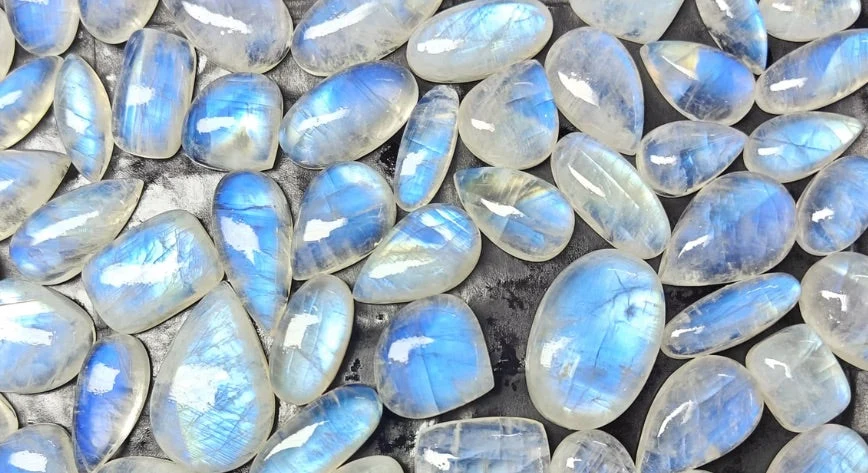
Rainbow Moonstone is actually labradorite with a pale base as opposed to the typical dark base that is commonly known. Rainbow moonstone has more intense flashes of blue and others colours echoing labradorite rather than traditional moonstone. Image courtesy of Gem Bazaar.
Labradorite: A Dramatic Reveal
Where moonstone is often delicate and softly luminous, labradorite can be dramatic, mysterious and intensely colourful.
At first glance, labradorite may appear grey, dark grey, brownish or almost black. Turn it towards the light, however, and it can reveal vivid flashes of electric blue, turquoise, green, and sometimes gold, orange and occasionally violet. Some stones display several colours at once, creating a remarkable effect against their darker body colour.
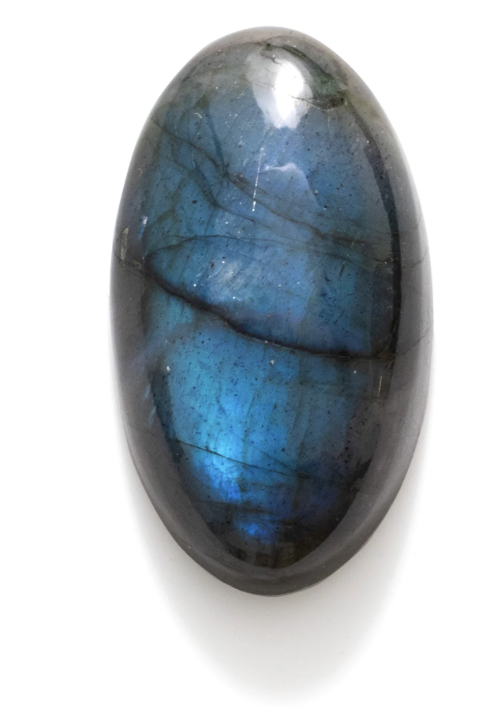
Labradorite Stone. Image courtesy of Kernow Craft.
Where Is Labradorite Found?
Labradorite was named after Labrador in Canada, where it was first described by European missionaries in the eighteenth century. It is also found in Madagascar, Finland, Norway, Russia and other locations around the world.
Finland is particularly associated with a striking variety known as spectrolite. This material can display a broad spectrum of intense colours and is highly valued by collectors and jewellery designers.
Labradorite is often cut as a cabochon to showcase its colour flashes, although it can also be carved or faceted. The way the rough material is oriented during cutting is particularly important: a beautifully coloured piece of rough can appear comparatively dull if cut at the wrong angle.
Labradorite Folklore
Labradorite’s dramatic colours have inspired stories of magic, protection and transformation. One Inuit legend tells of a warrior who struck the rocks with his spear, releasing the Northern Lights that had been trapped within them. Some of the lights escaped into the sky, while others remained in the stone, giving labradorite its colourful flashes.
In modern crystal traditions, labradorite is often associated with intuition, creativity, protection and personal transformation. These symbolic associations are popular among enthusiasts, although they are not supported by scientific evidence.
Are Moonstone and Labradorite Suitable for Jewellery?
Both gemstones can make beautiful jewellery and have been used by high end prominent jewellery designers, but their properties deserve consideration when choosing a design. Their natural colour flashes and moving optical effects make them particularly appealing in contemporary jewellery, where designers may use it to introduce a bold, celestial or almost abstract element into a piece.
| Designer / House | Era / Movement | Key Materials & Characteristics with Moonstone |
| René Lalique | Art Nouveau (1890–1910) | Used moonstones, moulded glass, enamel, ivory, and gold to focus on light transmission rather than traditional gemstone value. |
| Louis Comfort Tiffany(Tiffany & Co.) | Art Nouveau | Combined moonstones and black opals with enamel and gold, drawing inspiration from organic and botanical motifs. |
| Henri Vever (House of Vever) | Art Nouveau | Partnered diamonds and pearls with opals, enamel, horn, and moonstones in intricate nature-inspired settings. |
| Georges Fouquet | Art Nouveau | Collaborated with artist Alphonse Mucha; frequently incorporated opals, enamel, mother-of-pearl, and soft luminous stones. |
| Austy Lee | Contemporary High Jewellery | Modern art-jewellery designer known for incorporating Madagascar rainbow moonstones into intricate gold and precious gem pieces. |
| Boodles | Contemporary Fine Jewellery | British jeweler famous for featuring moonstones in signature lines like the Raindrop collection and bespoke cuffs. |
With a Mohs hardness of 6–6.5, moonstone and labradorite are softer than quartz, sapphire and diamond. They can therefore scratch through everyday contact with harder materials. More importantly, feldspars have cleavage planes, meaning they can split or chip if struck at the wrong angle.
Pendants and earrings are generally excellent choices because they are less likely to experience knocks and abrasion. Rings can also be lovely, particularly when worn occasionally or designed with a protective setting. Consider a bezel (rubover) setting, which surrounds the gemstone’s edge with metal, as it can help protect it from accidental impacts, and opt for a design that keeps the stone relatively low and shields its edges.
To care for either gemstone, use lukewarm water, mild soap and a soft cloth. Avoid ultrasonic and steam cleaners, harsh chemicals, sudden temperature changes and abrasive cleaning products. Do not use brushes including toothbrushes as this can scratch the softer surfaces. Remove gemstone jewellery before sports activities, gardening or household tasks where it might be knocked or scratched.
With appropriate care, both moonstone and labradorite can be enjoyed for many years.
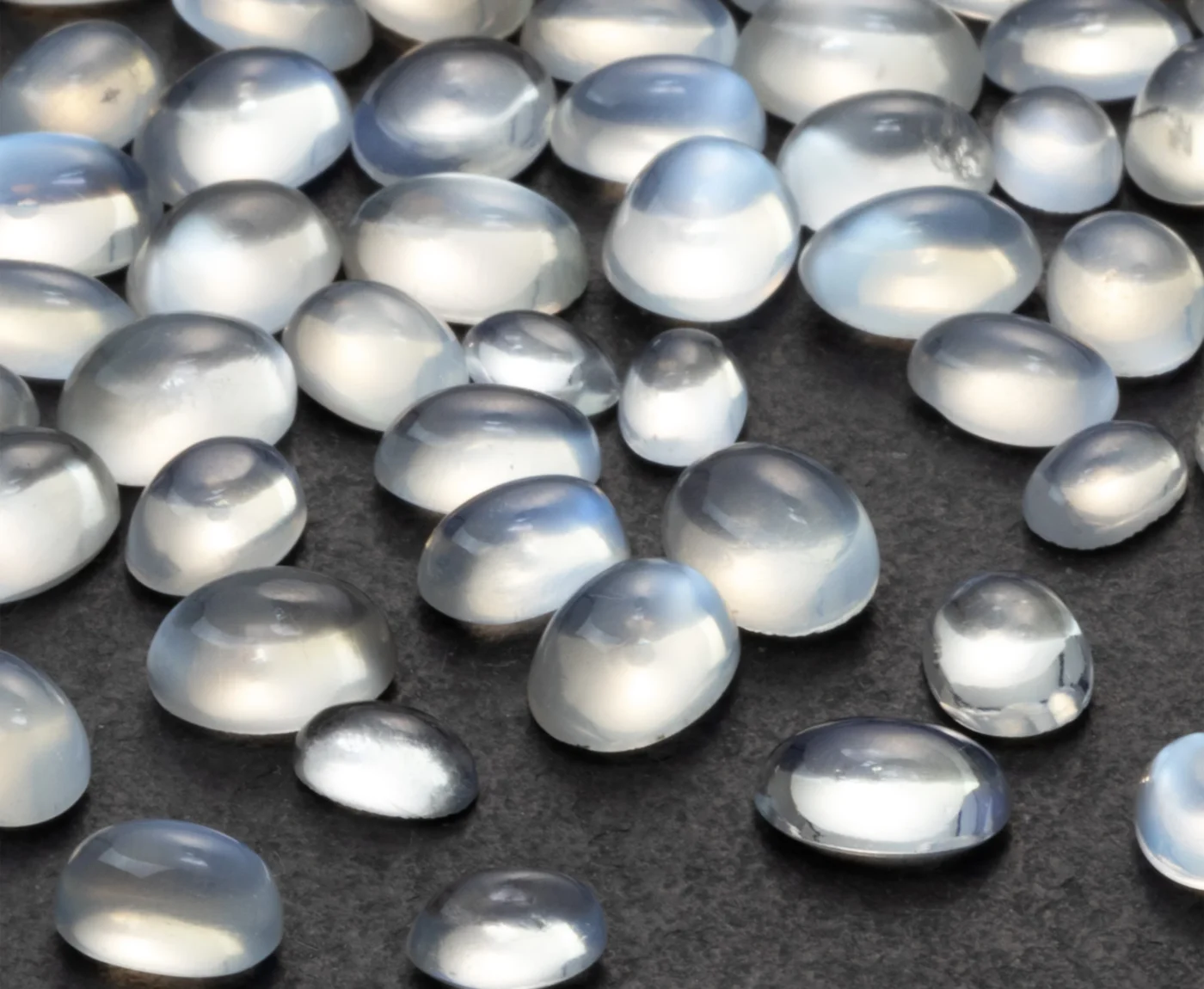
Traditional blue moonstone cabochon stones. A soft shimmer of blue on a translucent colourless base. Image courtesy of Kernow Craft.
Imitation Moonstones and Labradorites
As with many popular gemstones, imitations and misleading trade names do exist. However, it is important to distinguish between a natural gemstone, a synthetic material and an imitation. There are no known chemically-identical synthetic (laboratory-grown) versions of these gems but there are imitations.
Moonstone imitations may include glass, plastic or other materials manufactured to resemble its milky appearance and sheen. Some glass imitations contain a characteristic swirling effect or air bubbles. Not every stone with an attractive blue glow is necessarily moonstone.
Labradorite imitations may also be made from glass or other decorative materials. Synthetic or imitation opal-like materials and iridescent glass can sometimes be mistaken for colourful feldspar, particularly when sold without reliable descriptions.
Natural stones may also vary considerably in the strength and distribution of their optical effects. A weakly coloured specimen is not automatically an imitation, just as an impressive flash is not proof of natural origin.
Two Gemstones, Two Very Different Personalities
Moonstone and labradorite demonstrate just how extraordinary the natural world can be. Both belong to the same remarkable mineral family, yet each offers a distinct experience of colour and light.
Moonstone is prized for its soft, floating glow and romantic associations with the Moon. Labradorite, by contrast, offers a more dramatic display, with flashes of blue, green, gold and other colours emerging from a darker surface.
Neither relies on the sharp brilliance of a diamond to make an impression. Instead, their appeal lies in the way they change with movement, lighting and perspective.
For jewellery lovers who appreciate unusual gemstones, natural optical phenomena and a touch of mystery, both stones offer something special. Whether chosen for a delicate pendant, an expressive pair of earrings or a carefully designed statement ring, moonstone and labradorite remind us that some of nature’s most captivating effects cannot be fully appreciated until we see them for ourselves.
If you’re considering moonstone or labradorite gemstones for your jewellery pieces let us advise and guide you. Book your free consultation and let’s explore some designs together.
Related Posts