Jewellery Careers and How To Get Started
“What did you have to study to work in a jewellers?”
It is easily one of the most frequent questions we hear here at Timothy Roe Fine Jewellery. Customers glance through the windows into our workshop, admiring our craftspeople at their benches with miniature blowtorches, gravers, and polishing wheels, or listen to our sales consultants explain detailed information about the jewellery we make naturally wondering about our jewellery careers and what path leads to this kind of work. We love curious people and answering questions like these!
The answer is surprisingly simple: you don’t technically need a formal degree to get started. While basic foundation GCSEs in Maths and English are always useful, passion is the key. Honestly, many of us in the industry, if we weren’t born into it, fell into it by accident at different stages of our lives and have found our happy place here and stayed. The majority of us simply applied in person handing in a paper CV after seeing a job advert in the window. It is old school but is still very effective.
An eye for detail, a desire to create, and genuine enthusiasm and respect for the craft and all things sparkly and shiny will open doors and people will more likely give you a chance if they see you love jewellery. Putting your skills to the practical test is more important than just knowing the theory. Of course, theory is important, too and you’ll pick this up as you go because many of our skills and knowledge are gained through on the job learning.
Top Tips for Getting Started
Immerse yourself online: Follow independent manufacturing jewellers, watchmakers, and heritage brands on social media. Study their websites, note the fine details, and get familiar with their signature aesthetics.
Build a reference library: Most iconic jewellery Maisons have published coffee-table books celebrating their masterworks. Collect these, study the archive pieces, and read books on the specific disciplines that excite you.
Follow trade news: Keep up with industry publications, discover who the key figures and master craftspeople are, and observe current market trends. The more knowledge you soak up now, the easier it will be to speak the language when an opportunity arises.
Wear jewellery: Actions speak louder than words. If you want to work in the jewellery industry play with styling and curating your own collection even if it is silver or costume jewellery. Show you love jewellery by wearing it!

Our industry is remarkably niche and wonderfully close-knit albeit concentrated mainly around jewellery quarters like London, Birmingham, Manchester and Leicester with a few independents and chains dotted in between. It is built on family-run workshops, independent designers, and generational knowledge—anchored by trust, honesty and integrity. Almost everyone knows everyone; even internationally, and people are always eager to support newcomers to keep the craft thriving especially in a very driven AI world with mass-made factory-jewellery coming in from Asia.
Annual trade shows and industry events offer regular opportunities to network and catch up with colleagues. Alongside this community spirit, dedicated educational institutions provide ongoing courses, often supported by grants and bursaries, helping craftspeople fine-tune their skills and advance their careers.
Whether you’re academic or more practical, whether you want to work at the bench, discover rare gems, or run a bustling boutique showroom, or are just curious how we arrived here in our roles, here is an insider’s look into jewellery careers and how you can take your first steps. There is a place for everyone here and we like to think by sharing our insights, we might inspire you, the next generation and help our industry in the process.

Ring cleaning in the workshop

1. At the Bench: Manufacturing & Craft Roles
If you love working with your hands, manipulating raw materials, and losing yourself in fine, millimetre-precise details (micro-engineering), the manufacturing side of jewellery is where the magic happens. While you will find university courses and City & Guilds qualifications useful, apprenticeships remain the gold standard for the bench if you can get one. Sitting next to a master craftsperson every day teaches muscle memory, problem-solving, and patience with real customer examples in a way a classroom never could. If you have the space and money to set up your own mini bench at home, or in a shed, this is an amazing starting point to practice. There are hundreds of YouTube videos online and tutorials teaching you basic skills and these are free! Some of the roles below cross over and some people do multiple things. It depends on the skill set of the individual and how large the team is where they work.
- Goldsmith / Silversmith: General or specialised craftspeople who make, forge, assemble, and repair pieces from gold, silver, and platinum. They understand how precious metals react to heat, pressure, and hammer strikes and will spend a minimum of 10,000 hours learning their craft to be proficient. Their goal will be to become a master goldsmith.
- Bench Jeweller/Jobbing jeweller: The backbone of many retail workshops. Bench jewellers handle daily life in a jewellery house—ring resizings, re-tipping worn claws, chain repairs, and all those small jobs. Some may handle bespoke custom commissions.
- Diamond Mounter / Setter: These are high-precision disciplines. A mounter constructs the metal framework or claw basket from scratch, while a stone setter precision-fits diamonds and precious gems into claws, bezels, grain settings, or channel tracks using specialist microscopes and pushers. Usually the setters will have trained first as goldsmiths then specialised into setting work.
- Polisher / Finisher: Never underestimate the skill of a great polisher. They bring raw, cast metal to life using compounds, mops, and wheels, removing fire scale and imperceptible scratches to achieve an immaculate mirror finish or silky matte texture without rounding off sharp structural edges.
- Lapidary: Working with rough crystals, lapidaries cut, shape, and facet raw mineral rough into dazzling, symmetrical finished gemstones. Some study gemmology to understand the gemstones they are cutting but this is not a requirement. Attention to detail, good maths skills and a steady hand and much patience are key. Most cutting workshops will centre around jewellery quarters like London or will be in Thailand and India.
- Hand Engraver / Chaser: Using hardened steel tools called scorpers and gravers, engravers hand-cut decorative patterns, family crests, calligraphy, or deep relief seals into gold and silver. This is a craft that is in great demand. As many are retiring there are not enough people to continue this work and not enough young people learning this skill.
- Enameller: Blends fine art and chemistry by fusing ground coloured powdered glass onto precious metal surfaces at temperatures upwards of 800°C to create radiant, jewel-toned decorative finishes. Like hand engraving, this skill is also dying out as more people retire from this craft.

2. The Visionaries: Design & Creative Roles
Jewellery begins with an idea. Whether inspired by botanical forms, architecture, or an heirloom family gem, creative specialists bridge the gap between imagination and physical form. Drawing and painting skills, sculpture, crafting—if you like these things this might be for you.
- Jewellery Designer: Translates customer stories and style trends into wearable art. Today’s designers often blend hand-drawn sketches with Computer-Aided Design (CAD) software like Rhino, ZBrush or MatrixGold to produce photorealistic 3D models. Knowledge of bench work or access to liaise with workshops to ensure measurements and practical limitations is important. Thinking in a structural 3D perspective and having good drawing skills are vital in this role if you are not relying on pre-designed CAD templates.
- Wax Carver / Model Maker: Before metal is cast via the lost-wax-casting-process, some jewellers will create a master model. Wax carvers carve designs out of specialised carving waxes by hand or run high-resolution 3D wax printers. Polymer resin printers are also used by design teams to help customers visualise the piece before it is cast in precious metals.
- Illustrators: For high end luxury jewellers like Graff Diamonds or Van Cleef et Arpels they will have in-house illustrators paint gemstones and jewellery creations in gouache as artwork for their clients or for their own archives. Many will later produce books or hold exhibitions displaying these.
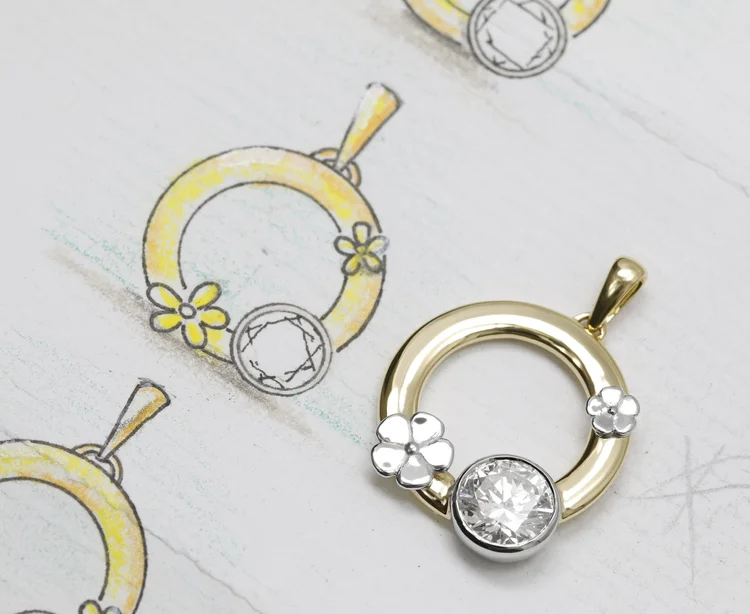
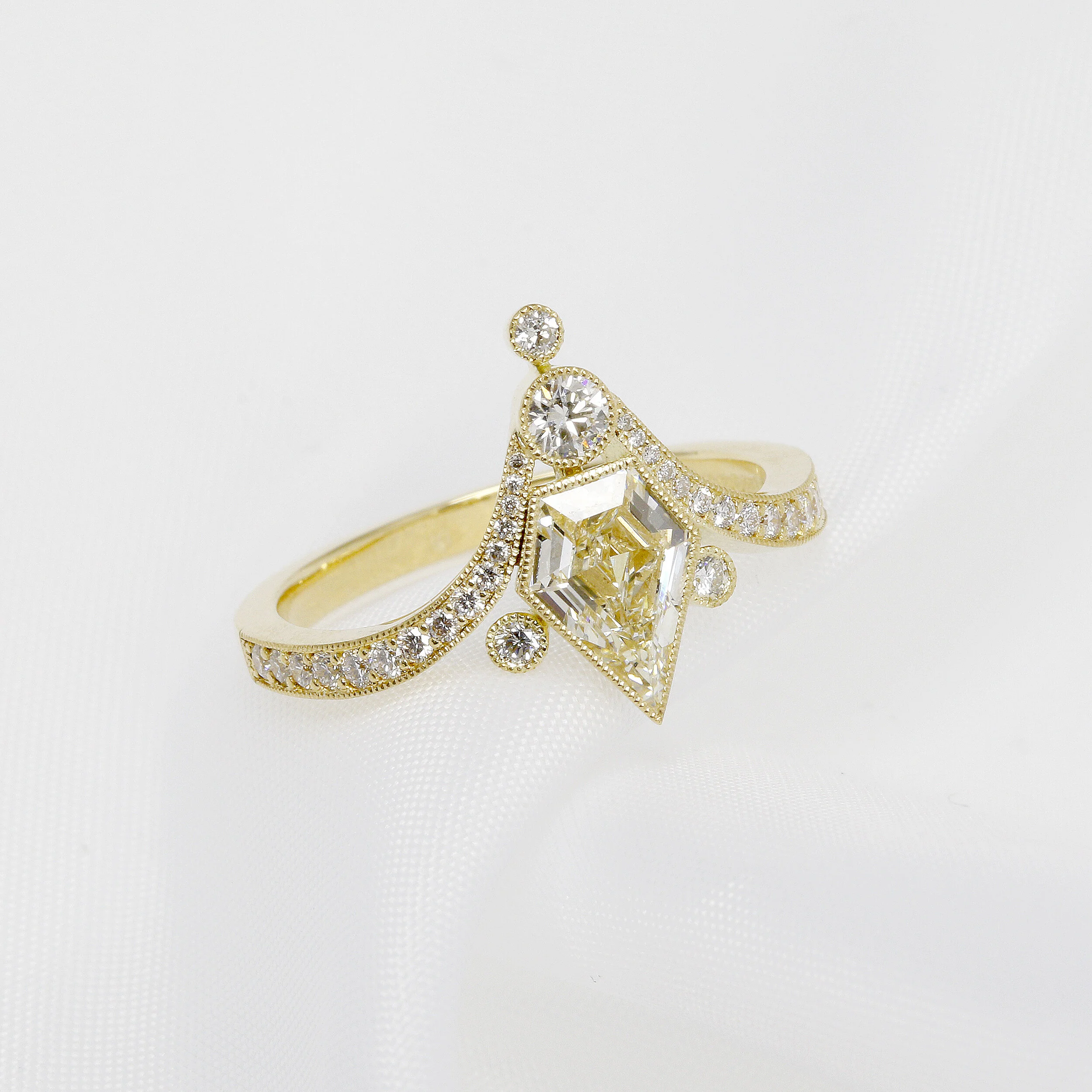
February 2024 – Customer Supplied Diamond in Yellow Gold and Platinum
3. The Science of Sparkle: Gemmology & Technical Roles
For those fascinated by mineralogy, chemistry & physics, and provenance, the technical specialist wing of the industry offers a rewarding, detective-like career path. If you are methodical, accurate, highly organised and meticulous, notice all the fine details and question “what if” or “why” then this is a role that might suit your curiosity.
- Gemmologist: The scientists of our trade. Equipped with refractometers, spectroscopes, and loupes, gemmologists distinguish natural earth-mined diamonds and coloured gemstones from lab-grown alternatives, imitations, and heat-treated stones. Most undertake formal diplomas through institutions such as the Gemmological Association of Great Britain (Gem-A) or the Gemological Institute of America (GIA). Gemmologists can work in retail jewellers, at gem grading laboratories or can become valuers.
- Jewellery Valuer / Appraiser: A role requiring deep technical expertise and market awareness. Valuers inspect modern and antique pieces to determine monetary values for insurance replacement, probate, or auction. Gemmological qualifications including diamond grading and a minimum of 5 years retail and 2 years in a manufacturing jewellers are needed as prerequisites to be a valuer. Experience in markets, finance and gold and business are all useful for this path.
- Assay Office / Hallmarking Technician: Part of a British legal tradition dating back to 1300. Working at one of the UK’s Assay Offices (London, Birmingham, Sheffield, or Edinburgh), technicians test precious metal purity using X-ray fluorescence and apply official hallmark stamps.
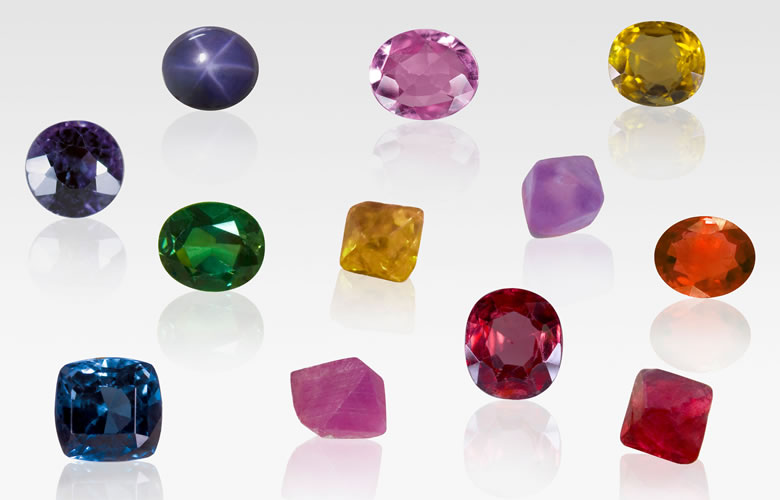
Various shades of spinel gemstones including star spinel stones. image courtesy of geology.com
4. The Front of House: Sales, Retail & Business Roles
A stunning piece of jewellery means little if it never finds a home. Retail sales roles are where customer relationships, celebrations, and emotional milestones happen. They are the link between you; the customer, and the bench who made the jewellery. This is also the easiest point of entry into the industry and will give you options and connections to move later into other areas and specialise. Again, many of these responsibilities may be performed by one job role or across several depending on the size of the team.
- Jewellery Sales Consultant: Far more than a typical shop floor role. You guide couples through choosing engagement and wedding rings, help families design bespoke heirloom pieces, and manage repair workflows. Empathetic listening, experience in luxury high-end customer service, confident IT skills, attention to detail and product knowledge are paramount. The NAJ (National Association of Jewellers) based in Birmingham offer JET 1 and JET 2 courses (Jewellery Education Training) for complete beginners to get up to speed quickly on jewellery, watches, clocks, gemstones, manufacturing, security, and law amongst other topics. These are a year long each and many jewellers often pay for these courses for their employees.
- Showroom / Store Manager: Keeps daily boutique life humming smoothly, managing team development and staffing rotas, stock curation, security protocols and balancing the finances at the end of each day amongst other duties.
- Jewellery Buyer / Gold Buyer: Sourcing curated collections from trade suppliers or materials for workshops, testing antique jewellery for resale, or evaluating scrap precious metals.
- Window Display & Visual Merchandising: Curating window displays that capture the eye of passersby, turning showroom vitrines into miniature art exhibitions.

5. External Specialists & Behind-the-Scenes Roles
Because our industry is so multifaceted, several niche disciplines keep the trade moving smoothly:
- Pearl Stringer: A delicate, traditional craft. Pearl stringers hand-knot pearls and bead necklaces onto silk thread, knotting between each bead to prevent friction and ensure stones aren’t lost if the strand breaks.
- Watch Specialist / Horologist: Specialists who repair, clean, regulate, and restore mechanical and quartz movements, balancing tiny balance wheels and microscopic gear trains. There are often apprenticeships in Switzerland (the heart of watchmaking) and other UK cities under large watch brands if you love micro-engineering and watches. Love a watch brand? Contact them directly to find out about their careers opportunities.
- Stone Dealer / Supplier: Sourcing parcels of diamonds, sapphires, tourmalines, and emeralds from mining hubs across Sri Lanka, Colombia, or Madagascar, and supplying them directly to workshops like ours. This job carries high risk and usually helps to be familiar with those countries, speak the language and have contacts there.
- Office & Workshop Admin: The unsung heroes who keep the businesses running, they coordinate job tracking, metal casting orders, keep the workshop flow going by assigning jobs to the right people at the right time, hallmarking runs, and customer communications so bespoke pieces arrive on time. They also process the invoices, post in/out and are the final control check point before signing off jewellery as completed.
- Marketing: The social media, newsletters and website team/s are running the campaigns, driving the visuals and keeping the interest alive across the business. They follow the trends, keep up with the international news and markets as they fluctuate and create an online shopping window to the boutique.
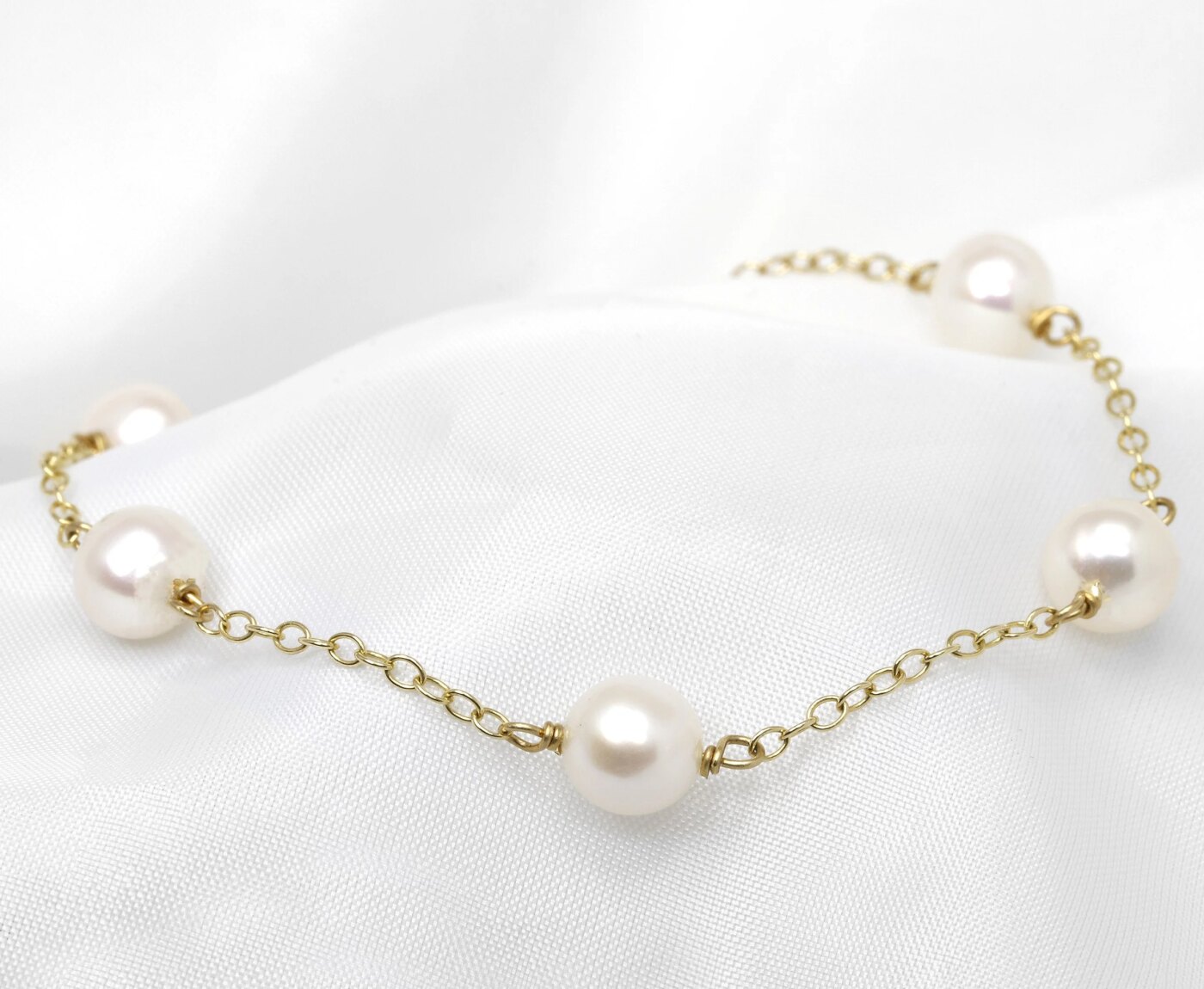
Pearl Station Bracelet in 9ct Yellow Gold
How to Get Your Foot in the Door
If you are looking to start a career in the jewellery industry, here are the most effective ways to stand out:
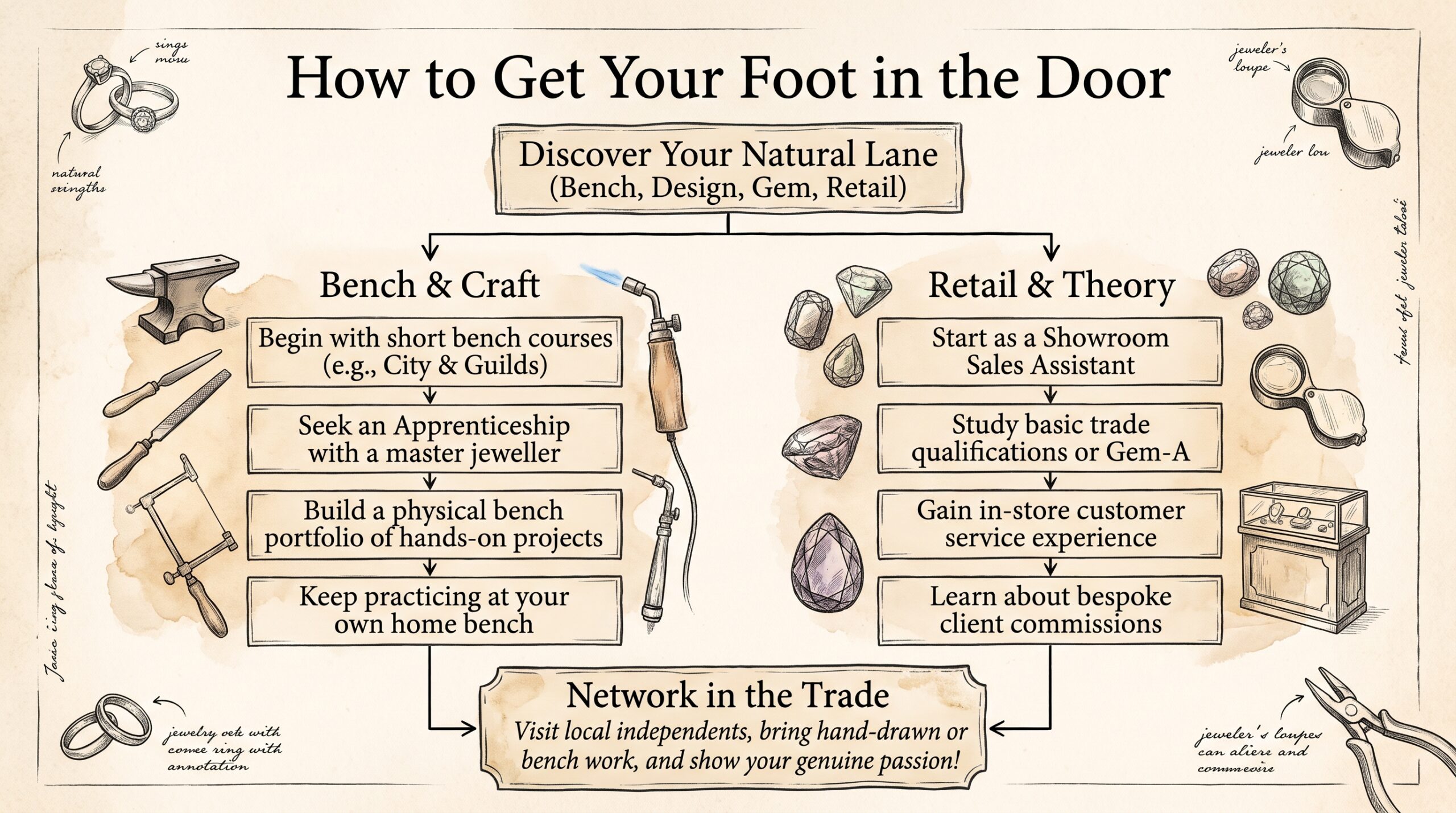
How to get started in the jewellery industry. Image created with Gemini Ai
- Be proactive with local jewellers whether a high street chain or an independent: Drop by jewellers in person rather than firing off generic online CVs. Showroom managers and workshop directors love meeting people who show real passion for the craft. Independents are likely to hire on this basis over chains who will have a corporate HR department and official channels.
- Build a visual portfolio: If you want to design, use CAD, or work at the bench, show what you can do. Include sketchbooks, wax carvings, wirework, life drawings, or metal projects you’ve made at home or during taster evening classes.
- Seek an apprenticeship: For aspiring goldsmiths, diamond mounters, and setters, reaching out to workshops and training bodies (such as the Goldsmiths’ Centre in London) or the NAJ (National Association of Jewellers in Birmingham) for apprenticeship programmes is the single best route.
- Take foundational or short courses: A basic weekend stone-setting, silversmithing, or Gem-A’s Gem Essentials course signals initiative and proves you understand what benchwork or gemmology actually entails.
- Start in retail or customer service: Many of the best goldsmiths, designers, and managers started by cleaning cases, taking in repairs, and speaking with customers on the showroom floor. Being inside a working jewellers gives you exposure to every facet of the business, connections and funding through grants. You can then explore career paths and network with the right people to make that happen.
The jewellery trade is one of the few ancient crafts where centuries-old hand techniques sit comfortably alongside modern laser welders and 3D design tools. Whether you begin by stringing pearls, sketching ring concepts, or sweeping the workshop floor as an eager apprentice, curiosity and pride in your work will take you a long way.
For anyone looking to take their first steps into jewellery, the UK has several industry-recognised institutions, training bodies, and apprenticeships. Reach out to jewellers and these educational centres because they are eager and keen to help and have contacts to nearly every business connected to the trade in the whole of the UK.
If you’d like more information about starting a career in the jewellery industry you might find some of the links below useful. We hope you enjoyed this article, let us know if you have any questions and who knows, maybe we’ll see you soon at a gem or jewellery trade show or welcoming you as a colleague in the future!
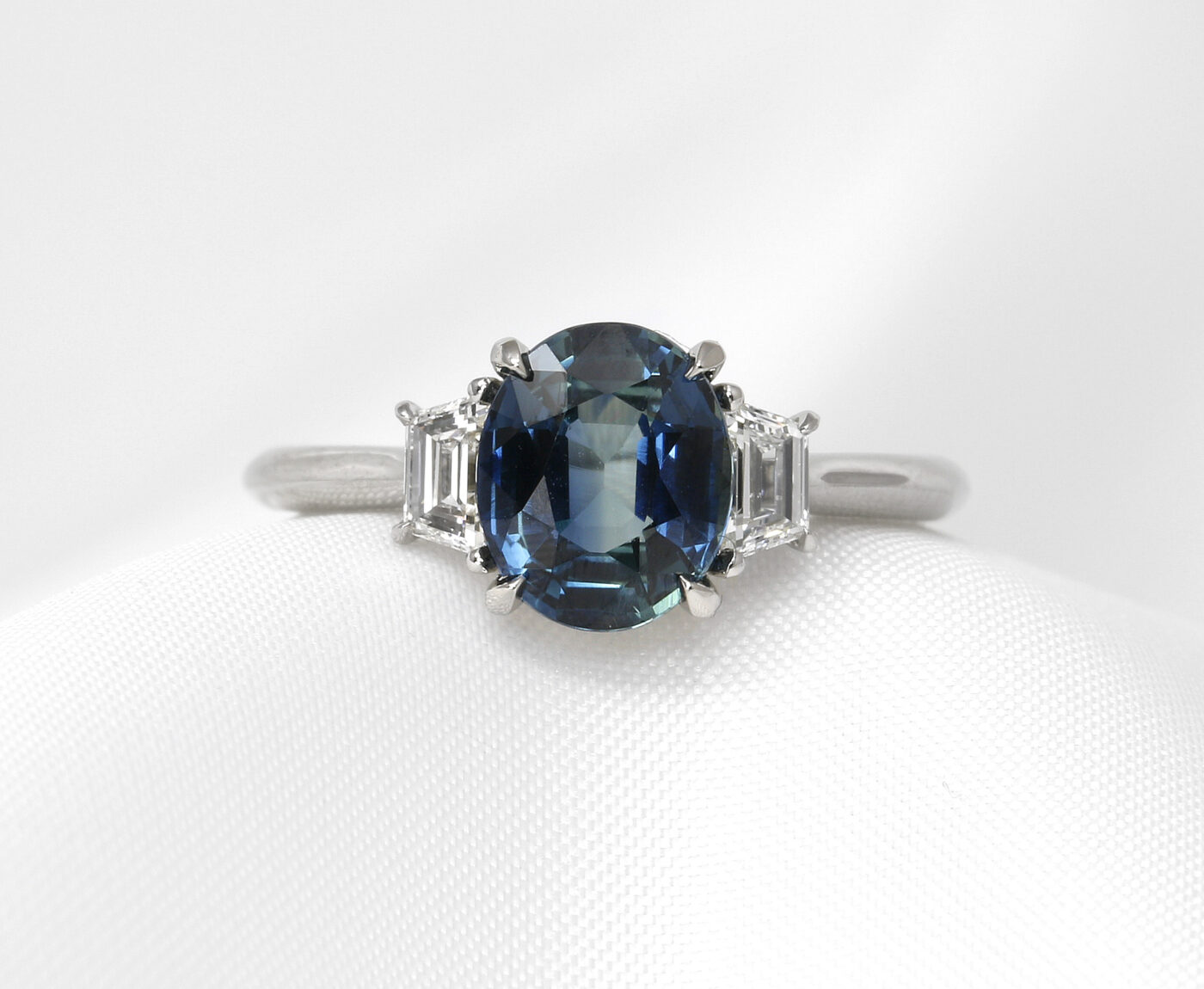
Oval Teal Sapphire and Diamond Three Stone Ring in Platinum
Training & Educational Centres and Courses:
1. The Goldsmiths’ Centre
Based in Clerkenwell, London, the Goldsmiths’ Centre is the premier educational and trade charity for precious metalwork in the UK.
- The Foundation Programme: A fully funded, 10-month intensive course (no tuition fees for accepted students aged 18+). It covers core bench manufacturing, stone setting, polishing, CAD, and metal metallurgy. It is widely regarded as the best stepping-stone into a formal bench apprenticeship.
- The Goldsmiths’ Company Apprenticeship Scheme (GCAS): One of the oldest continuous training schemes in Britain. Apprentices are bound to a “Master” workshop (usually in London or the South East) for several years of paid on-the-job training, with day-release tuition at the Centre. At the end of the apprenticeship, completing an approved masterpiece earns the maker the historic Freedom of the Goldsmiths’ Company.
2. British Academy of Jewellery (BAJ)
Originally founded as Holts Academy in Hatton Garden, the BAJ now operates campuses across London, Birmingham’s Jewellery Quarter, Sheffield, and Leicester.
- Level 2 & Level 3 Diplomas: Focus heavily on practical manufacturing, assembly, and CAD. Unlike broad academic art degrees, BAJ qualifications are tailored directly to commercially viable workshop techniques.
- Short & Evening Courses: Excellent for beginners to test the waters before committing to a full career change. They offer weekend and multi-week intensives in flush setting, claw setting, wax carving, CAD for Rhino/Matrix, and traditional hand engraving.
3. School of Jewellery
Located in the heart of Birmingham’s historic Jewellery Quarter (part of Birmingham City University), the School of Jewellery was founded in 1890 and is Europe’s largest jewellery school.
- Higher National Diplomas (HND) & BA (Hons): Ideal for those who want to blend high-level contemporary design, historic restoration, or horology with bench manufacture.
- BCU Short Courses: The school also runs evening classes and summer masterclasses for specific niche skills such as silversmithing, enamelling, and lapidary work.
4. Retail Excellence & Industry Accreditation: National Association of Jewellers (NAJ)
The NAJ is the principal trade association for the UK jewellery sector, providing dedicated education and training specifically designed by jewellers, for jewellers.
- JET Courses (Jewellery Education & Training): The industry standard for showroom staff, managers, and operational teams. Qualifications like JET Essentials, JET1, and JET2 build essential product knowledge across precious metals, gemstones, hallmarking, security, and consumer law.
- Specialist Pathways & Valuations: NAJ also provides the JET Foundations of Appraisal Practice (the essential stepping-stone towards becoming an Institute of Registered Valuers member) as well as JET Management & Leadership qualifications.
5. Gemmology & Valuations: Gem-A (The Gemmological Association of Great Britain)
For those aiming to become gemmologists, diamond graders, or auction valuers, Gem-A (based near Hatton Garden in London) is the world’s oldest, first and most respected gemmological institution.
- Foundation Certificate in Gemmology (Level 4): Introduces refractive index testing, spectroscopy, inclusion examination, and recognising natural vs. lab-grown or treated stones. Can be taken in-person in London or via distance learning from home.
- Gemmology Diploma (Level 6) & Diamond Diploma (Level 5): The global benchmark. Graduating from the Diploma allows you to use the prestigious post-nominals FGA (Fellow of the Gemmological Association) or DGA (Diamond Member), which are universally trusted across the global international trade.
- Birmingham University offers Gemmology and Jewellery Bachelor Degree for those wanting to mix both jewellery education and the science of gemmology as a more formal higher education qualification.
- The Gemmological Institute of America (GIA) based in Canary Wharf, London offers Gemmology Diplomas and Diamond Grading courses for professionals focusing on both the science and market value of gemstones including lore, history and story telling of gemstones.
6. Local Independent & Regional Bench Courses
If you cannot travel to London or Birmingham for full-time study, many regional craft guilds and independent academies offer targeted 1- to 5-day bench masterclasses:
- West Dean College in Chichester: Renowned for traditional metalworking, fine craft, and silversmithing weekend/week-long masterclasses.
- The Guild of Jewellery Designers: Provides listings for regional craft tutors, business support, and independent bench accreditations.
- Jewellers Academy in Brighton: Provides short courses, introduction courses for beginners and focuses on silversmithing skills.
- Farnham Jewellery School: Short workshops and courses for beginners in metalsmithing and enamelling.
- University of the Arts in London: Short beginner workshops, silversmithing, jewellery illustration day courses and enamelling for beginners.
- Trade fairs & open days: Attending open days at the Goldsmiths’ Centre or visiting industry events like jewellery shows and gem fairs is the quickest way to speak directly to industry colleagues and find out information through networking.
Related Posts