All about Garnets: Colours, Value, Meaning and Our Expert Buying Guide
Many people assume that garnets are dark, brownish-red stones with little variety. In reality, garnet gemstones are among the most fascinating and complex minerals studied in gemmology. Far from being a single stone, garnet is a group of closely related minerals forming what gemmologists call an isomorphous series. This means that small changes in chemical composition create entirely different types of garnet, each with its own colour, character and value.
Understanding the garnet family can be challenging, even for professionals. Many stones are a blend of two species rather than a “pure” variety, making identification both intriguing and technically demanding. For collectors and jewellery lovers alike, this complexity is part of the appeal.

Timothy Roe Rhodolite Garnet & Diamond Cluster Ring in Platinum £1,995.00
Garnet Colours and Species Explained
One of the most impressive features of garnet is its extraordinary colour range. While red garnet is the most familiar, garnets actually occur in almost every colour except blue in its pure form (though rare colour-change varieties can appear bluish in certain lighting).
The colour of garnet gemstones comes from trace elements such as iron, manganese and chromium. These subtle chemical differences also influence hardness, with garnets measuring between 6.5 and 7.5 on the Mohs scale — making them suitable for most types of jewellery.
There are five principal garnet species, all sharing the same crystal structure but differing slightly in chemistry and colours:
Almandine garnet typically displays deep purple-red to brownish-red hues.
Pyrope garnet ranges from rich crimson to orangey-red and includes the well-known blend rhodolite (a mix of pyrope and almandine) which is a stunning pinkish-red colour.
Spessartine garnet is celebrated for its vibrant orange and mandarin tones.
Andradite garnet includes some of the most brilliant green and yellow varieties, notably demantoid.
Grossular garnet has the widest colour range, from colourless to honey-orange (hessonite) and vivid green (tsavourite).
Among the most prized green garnets is Tsavorite, a vivid emerald-like stone found in East Africa. Another highly coveted variety is Demantoid, admired for its exceptional fire and brilliance.

Grossular Garnet: Timothy Roe Tsavorite Garnet and Diamond Cluster Ring in Platinum £6,275.00
Rare and Unusual Garnets
Anthill garnet, also known as chrome pyrope, is a fascinating deep red garnet found on Navajo land in Arizona. These tiny crystals are brought to the surface by ants as they build their mounds — hence the charming name. They are never bigger than 0.20ct but as little garnet stones for an eternity ring or pendant these are really quite novel!
Even rarer are colour-change garnets, which resemble Alexandrite. In daylight they may appear greenish-blue, shifting to purplish-red under incandescent light. So-called “raspberry blue” garnets, showing blue flashes with a pinkish-purple shift, are exceptionally scarce and mainly found in Madagascar and Kenya.
Garnets also possess high dispersion (fire). In darker stones this sparkle is often masked by high amounts of iron giving a strong body colour, but in lighter varieties such as demantoid, the brilliance can rival fine diamonds.
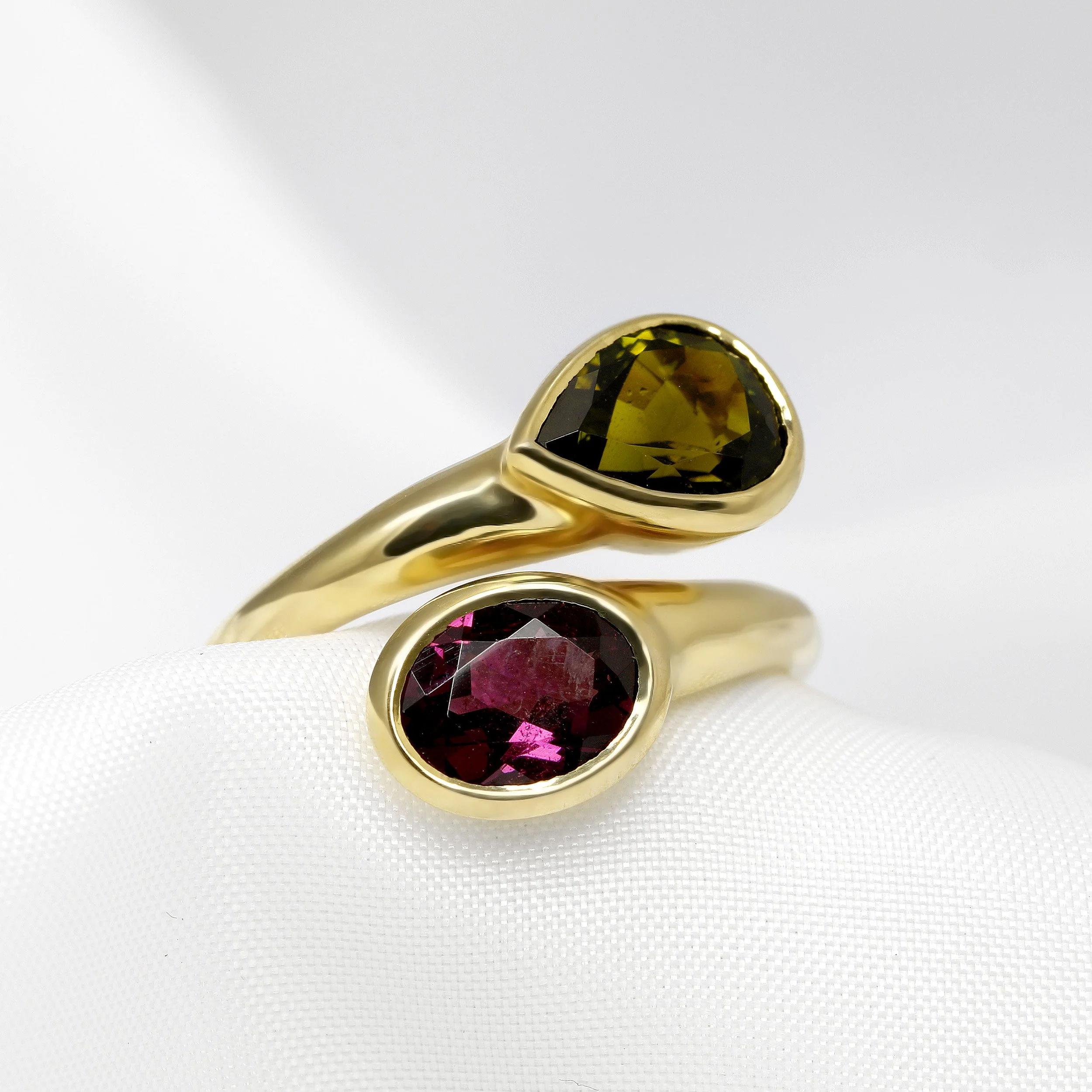
Almandine-Pyrope Garnet: Timothy Roe Garnet & Tourmaline Cross Over Ring in Yellow Gold £1,325.00
Where Are Garnets Found?
Garnets are mined worldwide, with notable sources including Australia, India, the Czech Republic, Myanmar, Madagascar, Kenya, Brazil and Sri Lanka.
Most garnets form deep within the Earth’s crust and upper mantle, sometimes at depths similar to diamonds. In fact, red garnet crystals have been found as inclusions within diamonds. Garnets share the same cubic crystal system as diamonds and commonly form beautiful dodecahedral crystals.
Red garnets are abundant in metamorphic rocks across every continent. However, not all garnets are common. Tsavorite, for example, is found only along the Kenya–Tanzania border and requires very specific geological conditions to form. It is often discovered as a by-product of mining for Tanzanite.
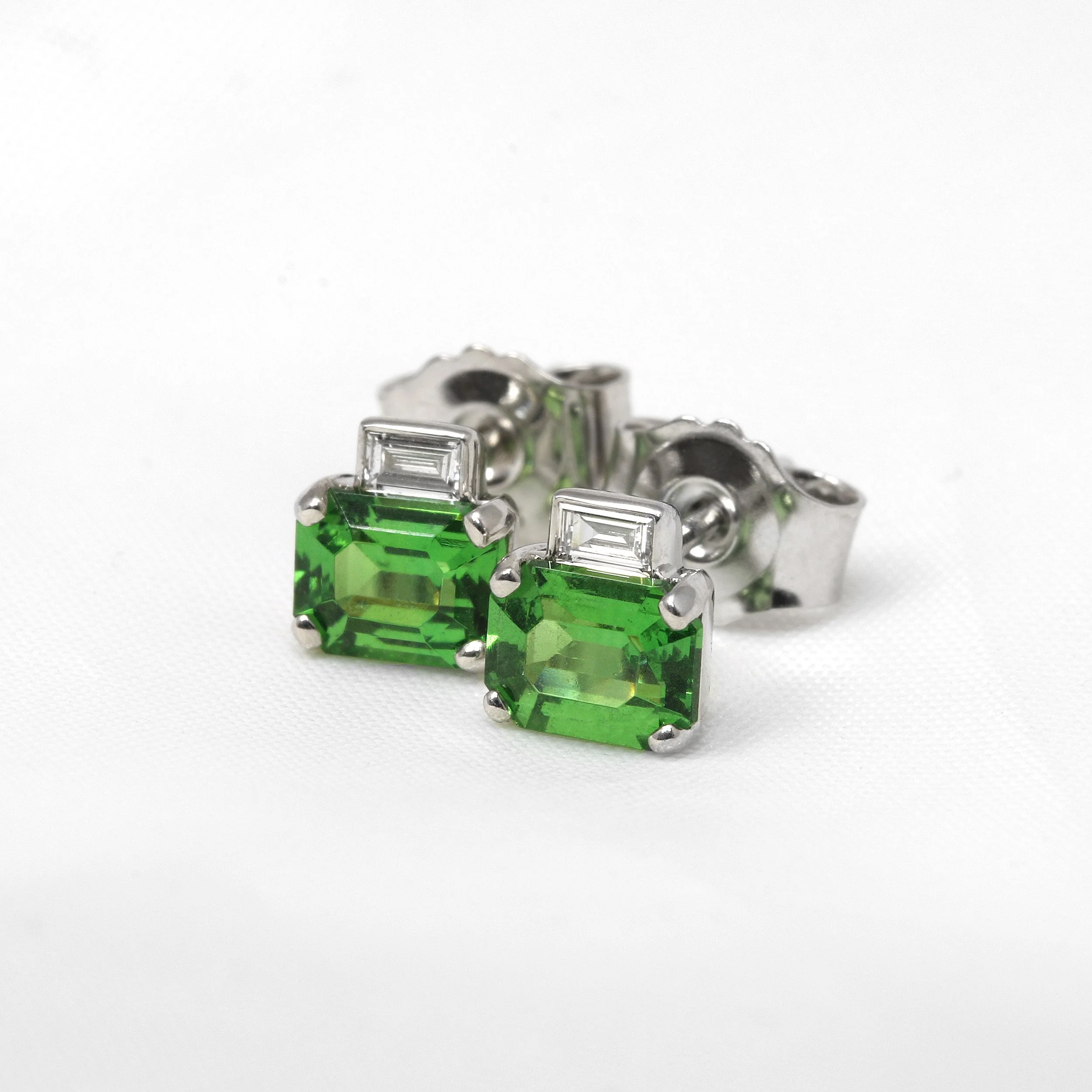
Grossular Garnet: Timothy Roe Tsavorite Garnet and Baguette Diamond Stud Earrings in White Gold £995.00
Garnet Inclusions and Identification
Inclusions in garnet gemstones are valuable identification clues and often help gemmologists distinguish garnets from other red stones such as ruby or spinel.
Common internal features include rutile needles, liquid inclusions, mineral crystals and gas bubbles. Some red garnets display intersecting rutile needles which, when cut en cabochon, can produce optical phenomena known as asterism (a star effect) or chatoyancy (cat’s eye effect).
In green Demantoid garnet, the famous “horsetail” inclusion — a radiating spray of golden-brown fibres — is highly prized. Unlike most inclusions, these actually increase the stone’s value and are sought after by collectors worldwide.
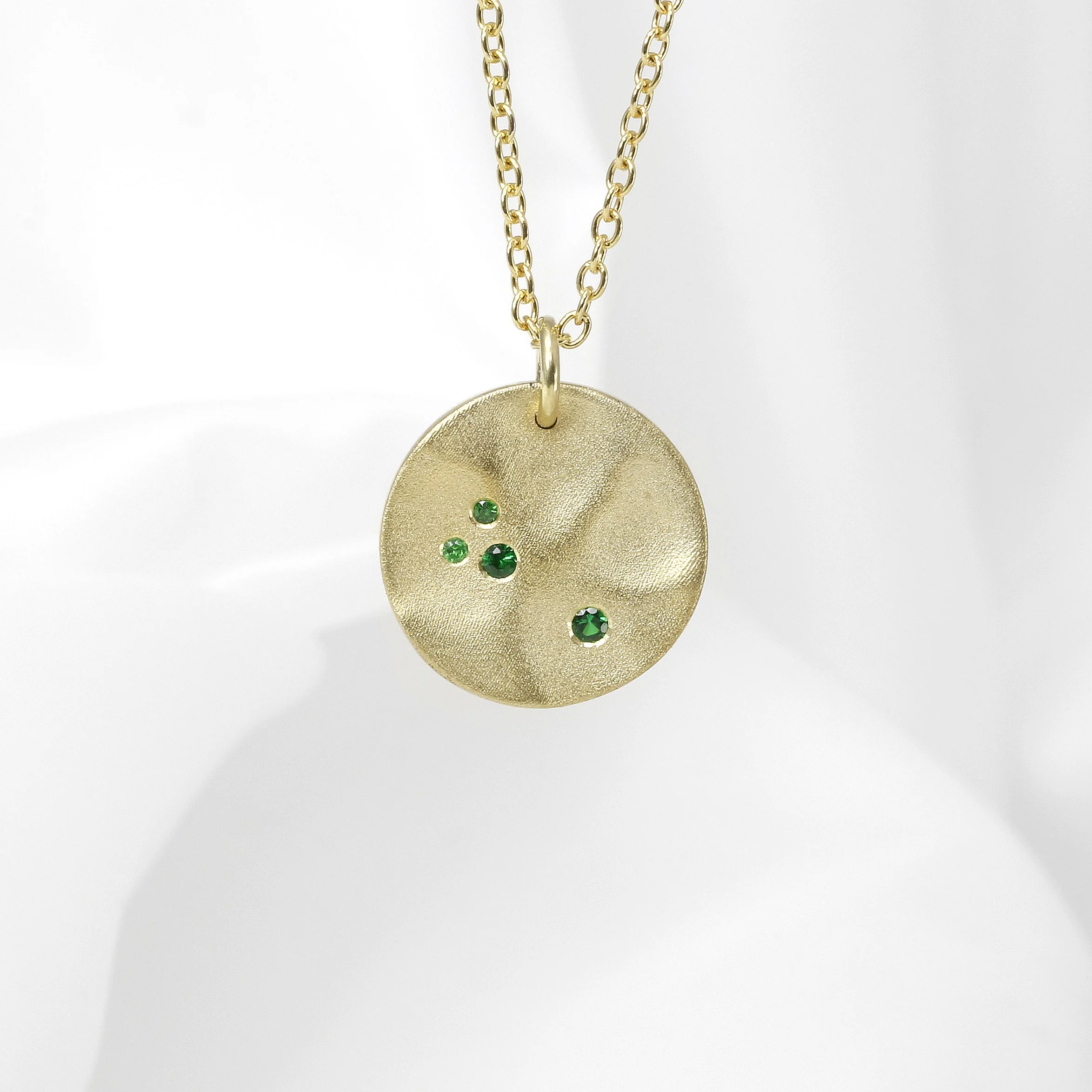
Grossular Garnet: Timothy Roe Medium Molten Disk Pendant with Tsavarite Garnets £710.00
Are Garnets Treated?
One reason garnet jewellery is so appealing is that garnets are rarely treated. Unlike many gemstones that routinely undergo heat treatment or irradiation, most garnets come out of the ground in their natural colour.
While very occasional heating or fracture-filling has been reported (primarily in demantoid), such treatments are uncommon. Garnets are widely regarded as one of the more natural gemstone options on the market.
Garnet Imitations and Doublets
The garnets most likely to be imitated are the classic red pyrope–almandine varieties. Glass (paste) is the most common imitation. It tends to scratch easily, shows worn facet edges and lacks the lively brilliance of genuine garnet.
An antique curiosity is the Garnet-Topped Doublet (GTD), a composite stone made from a thin slice of real garnet fused to coloured glass. These were historically used to imitate more expensive gems, including emerald and ruby. Under magnification, the join line or trapped air bubbles may be visible.
Synthetic garnet imitations such as cubic zirconia may also appear on the market. However, because natural red garnets are relatively affordable and abundant, laboratory-grown garnet is not commonly produced for jewellery purposes.

Almandine Garnet: Timothy Roe Cabochon Garnet Jardin des Delicés Ring in 9ct White Gold £850.00
Garnet Durability and Care
With a hardness of 6.5–7.5, garnets are durable enough for rings, pendants and earrings, provided they are worn with care. They should be protected from sharp knocks, and harder gemstones such as diamond, topaz or sapphire can scratch them.
Garnets are stable in normal light and resistant to most chemicals, though hydrofluoric acid can damage them.
For cleaning garnet jewellery, warm soapy water is the safest method. Ultrasonic cleaning is usually acceptable unless the stone contains fractures. Steam cleaning is not recommended.

Spessartine Garnet: Timothy Roe Mandarin Garnet and Diamond Ring in 9ct Yellow Gold
Garnet Meaning, History and Symbolism
Garnet has a rich and fascinating history. It is the birthstone for January and traditionally given to mark a second wedding anniversary.
The name “garnet” derives from the 14th-century Middle English word gernet, meaning dark red, which itself comes from the Latin granatum — “pomegranate” — a reference to the gem’s resemblance to pomegranate seeds.
Throughout history, garnet has been treasured by ancient Greek rulers, the Anglo-Saxon elite and Victorian royalty. During the medieval period, many red gemstones — including ruby, spinel and garnet — were collectively referred to as “carbuncles”.
House of Fabergé famously favoured demantoid garnets for their extraordinary fire. Garnet is also believed to have appeared on the biblical Breastplate of Aaron.
Often called the “Gem of Faith”, garnet was historically regarded as a talisman of protection, health and prosperity. Warriors carried it into battle, believing it would guard against injury and illness.

Grossular Garnet: Timothy Roe Tsavorite and Diamond Ring in Platinum £4,025.00
Why Choose Garnet Jewellery?
Whether you are drawn to deep red garnet rings, vibrant green tsavourite pendants or rare colour-change collector stones, garnets offer remarkable diversity, natural beauty and excellent value. Their wide colour palette, minimal treatments and fascinating history make them one of the most versatile and underrated gemstones available today.
For those seeking a gemstone that combines heritage, durability and striking colour, garnet is far from boring — it is truly extraordinary. Pop in to see us at Timothy Roe Fine Jewellery and explore our beautiful and diverse range of garnet stones and garnet jewellery.