Did You Know … We Purchase Your Gold
With gold prices at an all-time high since the pandemic, many people are choosing to sell old, unworn, or broken gold jewellery. But where can you do this, how do you do it, and more importantly, who can you trust? In this article, we’ll explain why gold prices are so high, what drives the gold rate, and what that means for you as a consumer. We’ll also explore your options when it comes to selling or reusing old gold and outline the key things to look out for when selling gold safely and fairly.

Why Is Gold So Valuable?
Gold has long been considered a “safe haven” asset during uncertain times. This belief stretches back centuries and became particularly ingrained during periods such as the First and Second World Wars. Gold is tangible, physical, and finite. Unlike paper or digital currency, it cannot be created at will, and it tends to retain value even when currencies weaken or inflation rises.
A striking historical example is Germany in the 1930s, where hyperinflation caused the Reichsmark to become almost worthless — at one point, a loaf of bread reportedly cost 6 million Reichmark. In situations like this, gold remains a viable commodity for trading. This idea of gold as a “rainy day pot” has become deeply rooted in our collective mindset.
Today, reserve banks hold gold bullion to stabilise economies, while investors, institutions, and high-net-worth individuals purchase gold bars and coins as part of diversified portfolios. All of this activity increases demand — and when demand rises, so does the price.
What Drives the Gold Price?
In simple terms, uncertainty drives gold prices. When people lose confidence in currencies due to economic, political, or social instability, they turn to commodities like gold that are perceived as stable stores of value.
When confidence returns and markets feel calmer, demand for gold typically softens and prices may fall. In the short term, gold prices fluctuate daily. Over the long term, however, gold has shown a clear upward trend. The gold rate is also backed on the US dollar so when the American markets fluctuate, gold responds accordingly.

Diamond Set Wide Band 'Wave' Ring in 9ct Yellow Gold £1,150.00
Gold Prices Today: A Record-Breaking Market
Gold prices have been steadily climbing for years, but the COVID-19 pandemic triggered unprecedented spikes as global uncertainty took hold. Since then, prices have continued to rise, often influenced by political decisions, global conflicts, and economic policy shifts.
In 2025, analysts predicted gold could reach $3,000 per ounce. It exceeded expectations, rising beyond $4,000 per ounce, with new forecasts for 2026 now approaching $5,000 per ounce.
This presents both opportunities and challenges. The cost of gold jewellery — including engagement rings and wedding bands — has nearly doubled over the past year. However, it’s worth remembering that gold has always been expensive relative to income and cost of living at the time. When we look back on past decades, gold only appears “cheap” in the past because we’re comparing it to today’s economy. Everything has risen alongside it — gold hasn’t moved in isolation.
Gold in Focus: Jewellery, Craft, and Longevity
Rising gold prices have renewed appreciation for gold jewellery not just as adornment, but as something enduring and meaningful. Despite higher prices, demand remains strong. In fact, we’re busier than ever. Customers are increasingly choosing bespoke jewellery over mass-produced pieces. Higher material value encourages more thoughtful design: clean lines, intentional weight, and craftsmanship intended to last generations. Heirloom-quality pieces are back in focus, replacing fast-fashion accessories. While gold prices are expected to rise more steadily this year — compared to last year’s dramatic increases — this will always depend on global economic and political stability.

So, What Are Your Options?
Buy Gold Jewellery Now
If you’re planning to buy gold jewellery — whether for an engagement, wedding, or as a long-term part of your core jewellery collection— purchasing sooner rather than later could save you money. As gold prices continue to rise, the longer you wait the higher the price will be, replacement costs will increase, and the pieces you already own are likely to appreciate in value. There is never a perfect time to buy gold jewellery. It is a case of jumping on board at the next opportunity. Many jewellers, ourselves included, do not increase their prices of items once they have been made so if you are a savvy window shopper you can likely find items of jewellery at excellent prices if these were made a year or more ago.
Remodel or Reuse Old Gold
If you have gold jewellery you no longer wear, remodelling is a cost-effective and sustainable option. Good-quality gemstones can often be reused in new designs, or your gold can be melted down to create a ring, bangle, or pendant. If you have enough gold, you’ll usually only pay for time and craftsmanship. If you don’t quite have enough, you can top up with additional gold supplied by us which is still far less expensive than supplying all new material. We will dive deeper into our ‘melt and make’ service in a future article but pop in to see us and we’ll happily explain the process in person.
Review Insurance and Valuations
As gold prices rise, many people find their jewellery is underinsured without realising it. Engagement rings and heirloom pieces in particular may no longer be covered at current replacement values. Updated valuations ensure your insurance reflects today’s market. Without this, you could face a significant shortfall if an item is lost, stolen, or damaged.
Sell Your Gold: What You Need to Know
With gold prices so high, selling unwanted jewellery can be financially rewarding — but it’s important to understand how the process works.
Buying Rate vs Selling Rate
Firstly, customers often confuse which rate they need to look at. You always need to approach it from the view of the company not the customer. The buying rate is the rate the company will purchase your gold at. The selling rate is what the company will sell gold to you at. It is not the other way around.
Secondly, the price you see quoted in the news is the spot price of gold — the electronic digital rate at which gold is traded between financial institutions. Jewellers and gold buyers cannot pay this rate directly to customers. This rate is not for physical gold.
Gold has to be found, mined, cast or formed, exported, imported, couriered with security companies etc. There are many steps and traders involved from when gold comes out of the earth to it becoming a gold bar or a piece of jewellery and these costs will all have to be factored into the end price the bullion dealer or jeweller is selling it for and this will be different to the spot price and vary across different companies.
When you buy gold jewellery, you are paying for the materials (metal and stones) plus craftsmanship, overheads, and retail margins but you will not get this back when selling. You cannot get the time and labour costs back that it took to make the jewellery. You only get the material value. When selling gold, you are paid a percentage of the gold’s intrinsic value (based on weight and carat). Buying and selling are two different things.
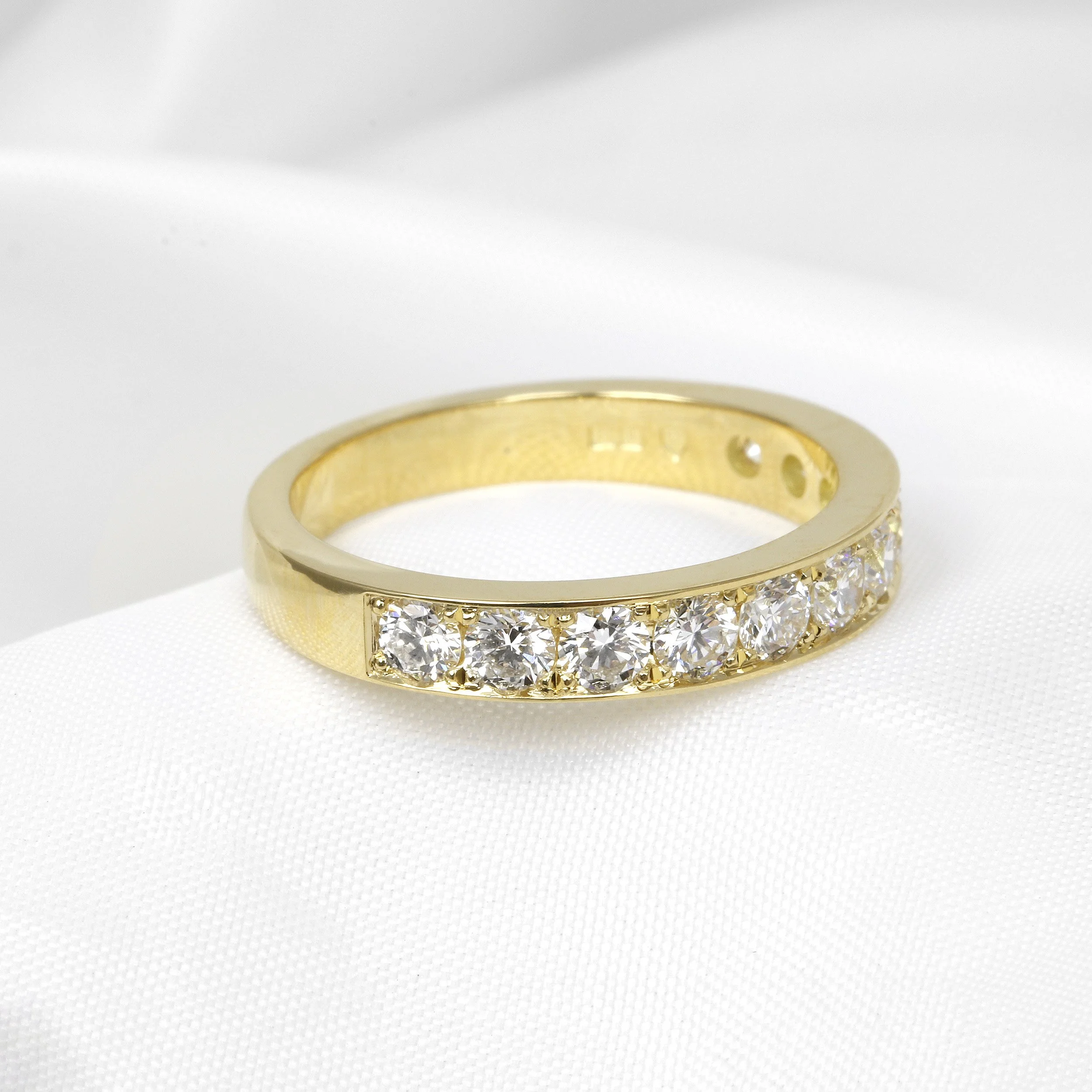
Diamond Grain Set Eternity Ring in 18ct Yellow Gold £2,995.00
Why Offers Vary Between Buyers
Not all jewellers offer the same price. This depends on what they do with the gold:
Some sell directly to refiners
Some trade with bullion dealers
Some recycle gold for their own workshop
Others resell high-quality items as second-hand or vintage jewellery
Each route carries different costs, risks, and timelines, which affect what a buyer can offer you. Most old jewellery that isn’t resold for the second hand market is melted down via refiners and recycled back into the jewellery industry.
Jewellery vs Bullion
Old gold jewellery is not the same as bullion bars or coins. Bullion operates in a separate market as a recognised investment product and is typically 22ct–24ct gold. At these high purities, gold is almost pure and therefore very soft. Jewellery, by contrast, is rarely made in 24ct gold and is not considered an investment product.
Gold jewellery is always alloyed — mixed with other metals — to improve durability and suitability for everyday wear. While craftsmanship, design, and labour contribute significantly to the retail price of jewellery, these factors are not reflected in the offer when selling. Jewellers generally pay only the intrinsic gold value — the amount of pure gold contained in the piece — rather than a bullion trading rate, even if the item is 24ct.
Bullion dealers can often offer slightly higher rates for bars and coins because they can resell them immediately at the current market price. Their rates for old gold jewellery, however, will vary and are typically lower than bullion rates. With bullion bars, ingots, and coins, dealers can buy from one customer and sell directly to the next, allowing for rapid turnover.
Most jewellers do not trade in bullion. If they purchase coins or bars, these are usually passed on quickly to refiners or bullion dealers to maintain cash flow and manage price fluctuations. Because additional parties are involved — each taking a margin — jewellers are unlikely to match bullion dealer rates. When selling old gold jewellery or bullion to a jeweller, it’s important to understand that the gold usually continues along the supply chain rather than stopping there.

14x12mm Cushion Signet Ring in 9ct Yellow Gold £1,225.00
Selling Old Gold: How Does it Work?
The Legal and Practical Side
You must be 18 or over and the legal owner of the gold
Valid photo ID (passport or driver’s licence) is required
Cash payouts are now rare — same-day bank transfers are the standard
Be cautious of anyone offering cash
A reputable buyer should clearly record and give you a receipt for:
The carat of your gold
The price per gram on the day
The total weight purchased
Your details and their details for the sale
Testing and Weighing Gold
Unhallmarked pieces are usually tested using an acid test. This is a controlled, on-site process, is very accurate but does involve lightly filing the surface to check for plating. Your consent must always be obtained beforehand because this test is destructive and will leave marks.
Gold is separated and weighed by carat fineness, not by individual items. All 9ct gold is grouped together, all 18ct together, and so on — regardless of colour (yellow, white, or rose).
The higher the carat, the more pure gold the piece contains, and the higher the price per gram. Common carat values include:
9ct
14ct
18ct
22ct
Due to fluctuating market rates offers are usually only held for that day otherwise the amount has to be recalculated at the new rate if the customer does not accept straight away.
Selling gold doesn’t need to be confusing or intimidating
Understanding how prices are set, why offers differ, and what to expect from a reputable buyer ensures you can make informed decisions — whether you choose to sell, remodel, or simply hold onto your gold as its value continues to rise. Do, however, do due diligence and research the company you would like to sell your gold to. Ask them how their process works, and don’t be afraid to ask what they do with the gold afterwards. A legitimate company will be transparent and happy to answer these questions. Do read Google and online reviews for the companies and compare rates to find the best one. When selling to jewellers check they are a member of the National Association of Jewellers for added reassurance and protection. Weigh your gold first at home on kitchen digital scales, try to find the hallmarks and photograph the pieces to ensure you know what you are selling. Some items may need testing if there are no hallmarks so go to a jeweller you trust.

Traditional Chain Link Yellow Gold Oval Cufflinks £1,240.00
Speak to Us Before You Decide
If you’re considering selling, remodelling, or simply want to understand what your gold is worth, we’re always happy to help.
At Timothy Roe Fine Jewellery, we offer clear, honest advice with no pressure to sell. We can assess your gold, explain your options, and provide same-day offer* based on current market rates, so you know exactly where you stand.
Whether you have a few broken pieces, inherited jewellery, or the odd bullion item, you’re welcome to visit us in-store for a confidential consultation. Ask questions, explore possibilities, and make an informed decision with guidance you can trust.
For further reading here are some articles you mind find useful:

Blog Article: A Guide to Jewellery Valuations

Blog Article: Do I Need to Insure my Jewellery?
Blog Article: What Does Carat Mean in Gold? An Expert Guide
* Any same-day verbal offer provided is preliminary and non-binding. Testing and weighing requirements, or a high volume of items, may extend the assessment period by several days, during which rates may fluctuate. The final applicable rate will be the rate in effect on the date the final offer is issued via email. Most testing and offers are completed on the same day (though it is not guaranteed). Bank transfers may take up to 5 working days. We require photo I.D.