All About Amethyst: An Expert Guide to Amethyst Jewellery
Amethyst has captivated jewellery lovers for centuries. From royal courts to modern collections, this beautiful purple gemstone remains one of the most popular and versatile choices in fine jewellery. In this expert guide, we’ll explore what amethyst is, where it comes from, its fascinating history, accepted treatments, care advice, and the rich lore surrounding this remarkable stone. For February birthdays or lovers of the colour purple— this stone and article is for you!
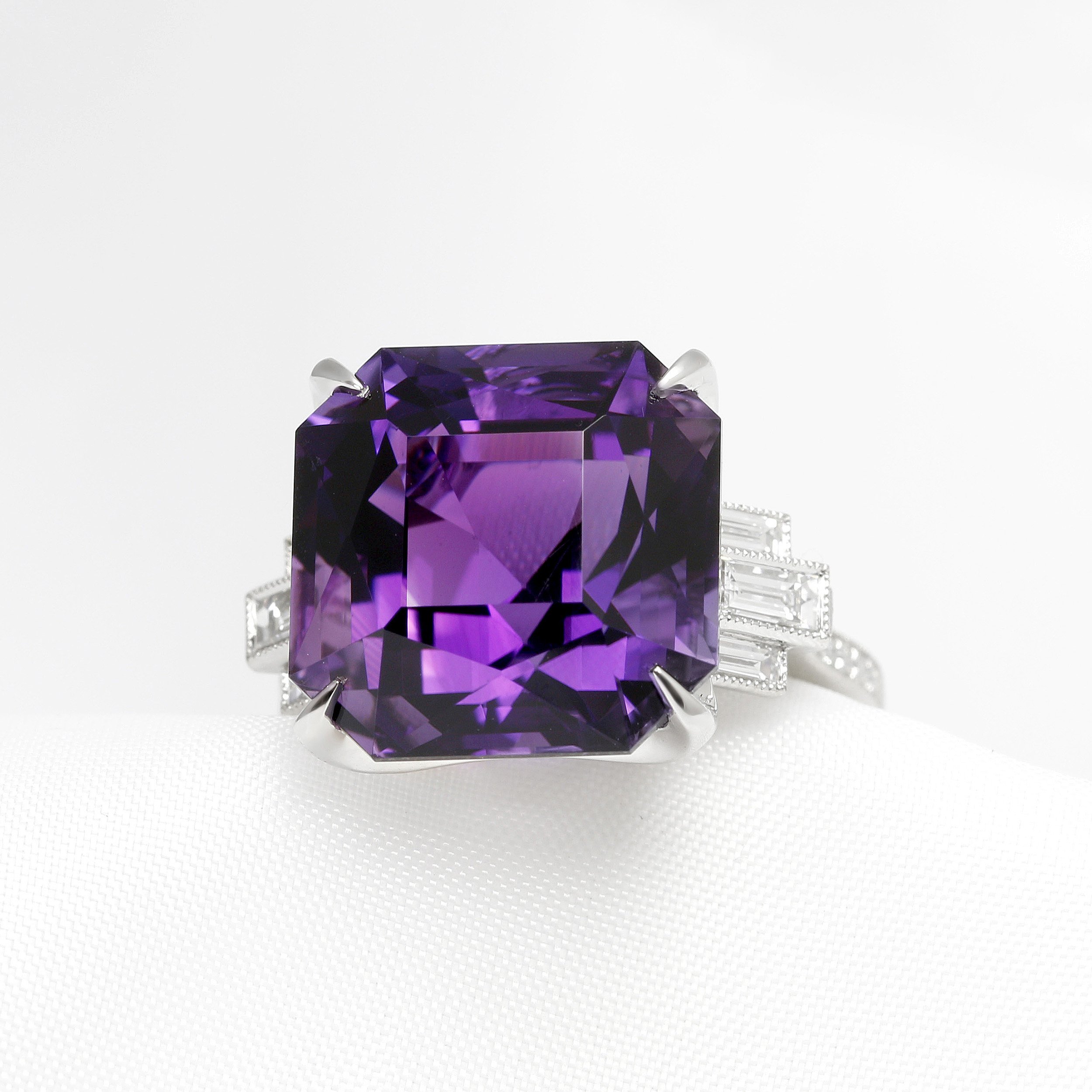
Amethyst & Diamond Cocktail Ring in Platinum £4,500.00
What Is Amethyst?
Amethyst is a member of the quartz family — one of the most abundant mineral families on Earth and makes up a significant portion of the Earth’s crust. In order to understand amethyst we also need to look at the quartz family it comes from because other gemstones are a product of treating amethyst like citrine and prasiolite.
Quartz is known for its glassy (vitreous) lustre, transparency ranging from clear to opaque and a wide spectrum of colours. It can feature some beautiful natural patterns and optical effects, too from internal inclusions and growth formation lines. Amethyst is the purple variety of quartz, prized for its rich colour and excellent durability for jewellery.
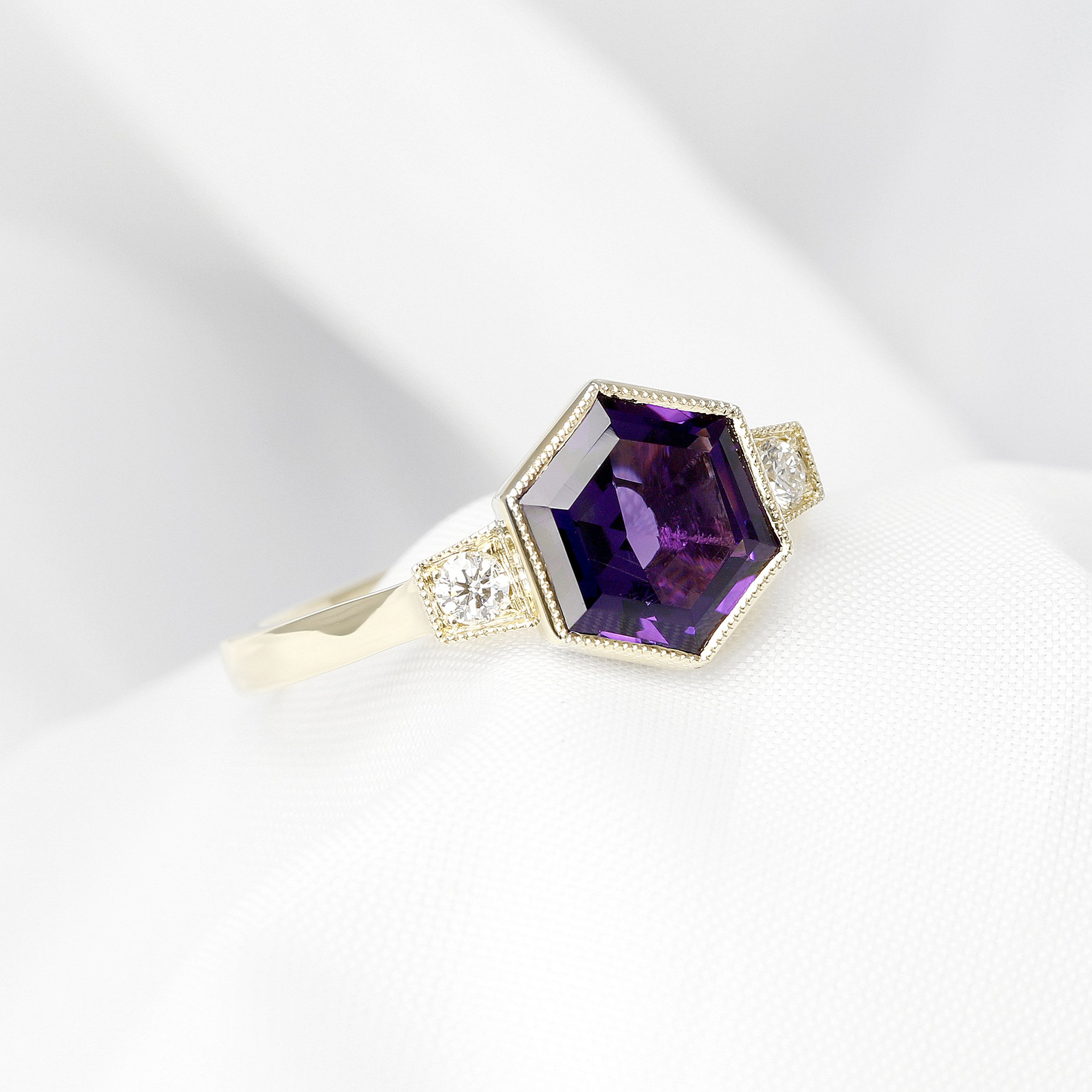
Hexagonal Amethyst & Diamond Ring in 9ct Yellow Gold £735.00
Where Does Quartz Come From?
Quartz is found worldwide, but some of the most significant deposits are located in:
Brazil (the largest and most abundant source)
China
France
Japan
Madagascar
Myanmar (Burma)
Russia
Switzerland
USA (notably Arkansas)
Brazil remains the leading global source, especially for amethyst.
The Versatility of Quartz in Jewellery
In jewellery, you’ll encounter quartz in many colours, including:
Rock Crystal – colourless
Amethyst – purple
Citrine – golden yellow
Smoky Quartz – soft brown
Prasiolite – green
Rose Quartz – pink
Interestingly, all quartz begins as colourless. The colours we see are caused by trace elements within the crystal structure and exposure to irradiation or heat, which alter its appearance. Quartz is commonly cut into:
Faceted gemstones
Cabochons
Beads
Decorative carvings
Intricate intaglios

Chrome Diopside, Amethyst & Diamond Ring in 9ct Yellow Gold £1,650.00
The History of Quartz
Quartz has been admired and utilised since ancient times. The Ancient Egyptians used it in carvings and ornamental decoration. Colourless quartz was used in early optical experiments and lenses. During World War I, quartz played a vital role in radio technology. This development eventually led to its use in watches, early televisions, and computers due to its piezoelectric properties. While quartz has found applications in many industries, it has always maintained a strong presence in jewellery.
Accepted Treatments on the Market
Irradiation & Heat Treatment
Colourless quartz containing traces of iron becomes purple amethyst when irradiated. Smoky Quartz is colourless quartz that contains aluminium impurities which turn a soft mocha brown colour when irradiated. Irradiation is a safe and widely accepted treatment on quartz.
When heated, amethyst may turn:
Golden yellow (citrine)
Green (prasiolite) Some people call this green amethyst but this is incorrect and the term prasiolite should be used
The concentration of trace elements determines the final colour outcome when heated.
Ametrine
“Ametrine” is a bi-coloured quartz that displays both purple (amethyst) and yellow (citrine) and usually is cut into an elongated octagonal form to really show off its pronounced colours.
Important Care Note
Although heat and irradiation treatments are accepted, quartz colours can fade with prolonged UV exposure. Proper storage is important to maintain colour integrity.

Amethyst Carved Half Hoop Ring in 9ct Yellow Gold £1,050.00
How to Clean and Care for Amethyst to Prevent Fading
Amethyst ranks 7 on the Mohs hardness scale making amethyst relatively durable and suitable for everyday jewellery, though care is still required.
Care Guidelines
Store away from prolonged direct sunlight (UV exposure can fade colour).
Avoid wearing while sunbathing or in strong direct sunlight for extended periods.
Remove before gym workouts or heavy cleaning.
Avoid exposure to chemicals and solvents.
Be cautious with ultrasonic cleaners.
Protect from knocks and hard impacts.
Avoid high heat exposure.
Prolonged UV light can reverse the irradiation process, gradually returning treated quartz to a lighter or colourless state.

Amethyst & Diamond Signature Cocktail Ring in 9ct Yellow and Rose Gold £3,525.00
The Lore and Symbolism of Amethyst
Quartz varieties each carry their own rich folklore so here we dive into the top myths and legends around the top three quartz gemstones.
Amethyst
Birthstone for February
Historically believed to prevent intoxication (its name derives from the Greek amethystos, meaning “not intoxicated”)
Associated with Dionysus, the Greek god of wine
Worn to promote clarity, focus, and sobriety
A symbol of royalty and spiritual wisdom in medieval Europe
Featured on the Biblical High Priest Aaron’s breastplate
Once considered as valuable as rubies and emeralds until major Brazilian deposits were discovered in the 19th century
Citrine
Birthstone for November
Known as the “Merchant’s Stone”
Associated with prosperity and success
Linked to:
Ra (Egyptian Sun God)
Demeter (Greek mythology)
Apollo (Roman mythology)
Rose Quartz
Known as the “Stone of Unconditional Love”
Believed to promote romance, emotional healing, and compassion
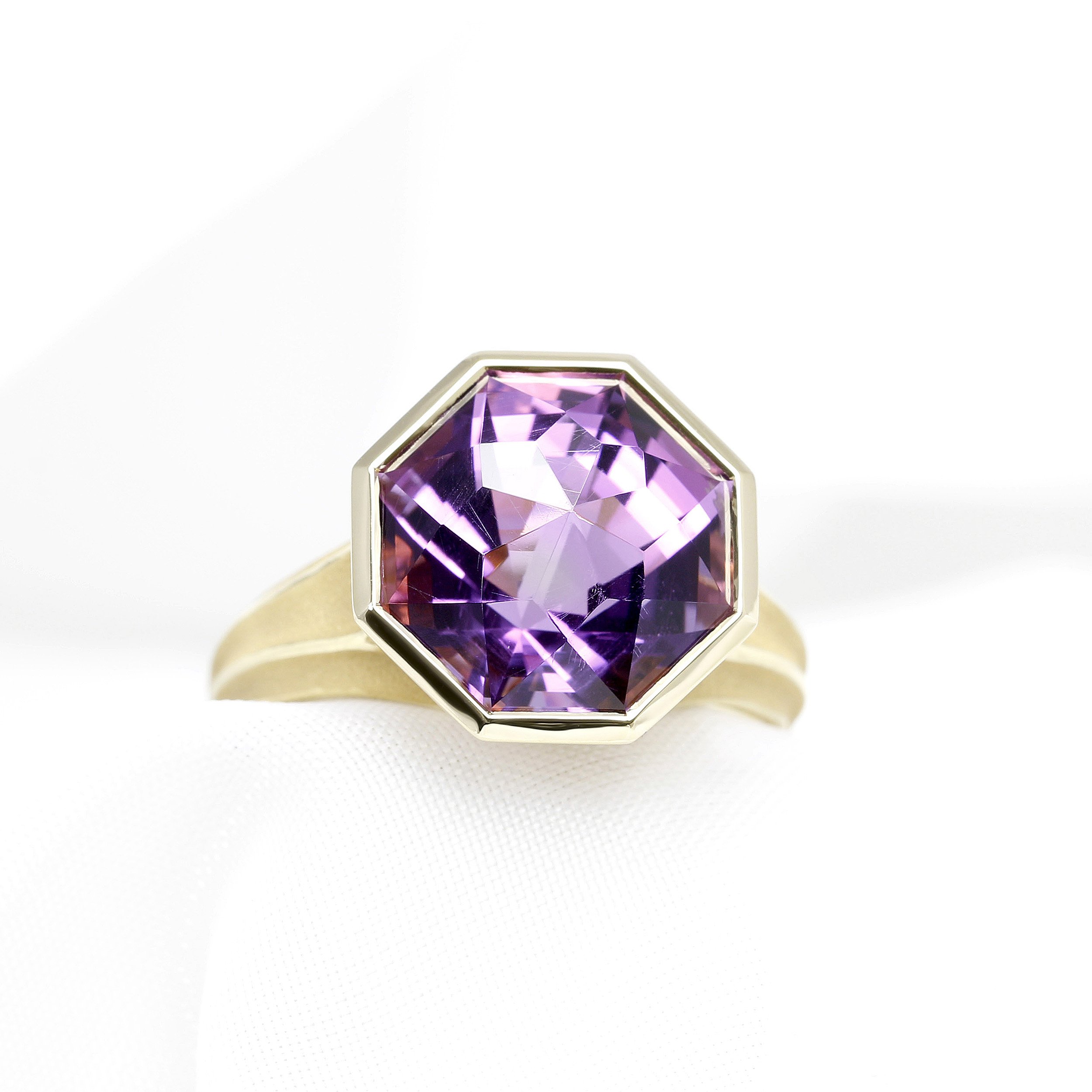
Amethyst Cocktail Ring in 9ct Yellow Gold £995.00
Choosing Amethyst Jewellery
When selecting amethyst jewellery, consider:
Colour – Rich, even darker purple tones are most valued.
Clarity – Amethyst is often eye-clean.
Cut – Good cutting enhances brilliance and colour depth.
Setting – Because of its hardness, it works well in rings, pendants, earrings, and bracelets and looks beautiful in warmer gold tones.
Amethyst offers exceptional beauty at an accessible price point, making it ideal for both everyday wear and statement pieces.
Final Thoughts
Amethyst is far more than a beautiful purple gemstone. It is part of a vast and fascinating mineral family with deep historical roots, scientific importance, and enduring symbolic meaning.
Whether you are drawn to its regal colour, its lore, or its versatility in jewellery design, amethyst remains a timeless and elegant choice.